Wedding vs Corporate Event Management: What's the Difference?
September 18, 2026 | Written by Max Events
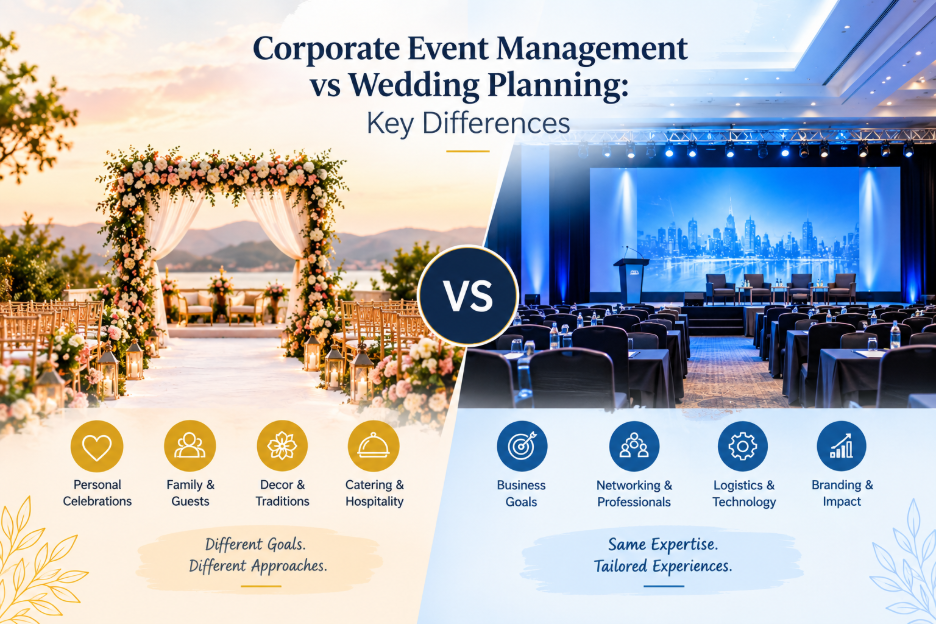
Planning an event is never simply about choosing a venue, arranging decorations, and inviting people. The approach changes significantly depending on whether the event is a wedding or a business gathering. Understanding the difference between wedding planning and Corporate Event Management can help clients choose the right planning strategy, budget properly, and create an experience that achieves its purpose.
For weddings, the focus is usually on emotions, traditions, family expectations, personal style, and memorable guest experiences. Corporate events, on the other hand, are built around professional objectives such as networking, brand communication, employee engagement, conferences, product presentations, or business development. Maxevents understands these differences and plans each event according to its purpose, audience, and scale.
What Is the Difference Between Wedding Planning and Corporate Event Management?
Wedding planning is primarily people- and experience-focused. A wedding planner coordinates several elements, including the ceremony, reception, décor, entertainment, catering, photography requirements, guest arrangements, and scheduling.
Corporate Event Management is more objective-driven. A corporate event may involve conferences, meetings, exhibitions, product launches, promotional activities, award functions, employee events, or business gatherings. Every element needs to support the organization's purpose and maintain a professional environment.
The key difference is simple: wedding planning creates a personal celebration, while corporate event management delivers a strategic business experience.
Why Does the Purpose of the Event Matter?
The purpose determines almost every planning decision.
A wedding may be designed around a couple's personality, cultural traditions, family preferences, and desired atmosphere. The planner has to create an emotionally meaningful experience while coordinating several people and suppliers.
A corporate event has measurable objectives. The goal may be to educate attendees, introduce a product, build professional relationships, celebrate achievements, or communicate an important company message.
This is why the same planning method cannot be applied to every event. Maxevents begins by understanding the objective before developing the event concept.
How Are the Stakeholders Different?
Who makes decisions is another major difference.
Wedding planning normally involves the couple and their families. Parents, relatives, close friends, and other family members may have opinions about traditions, food, décor, entertainment, and guest arrangements.
Corporate events often involve several professional stakeholders. Management, marketing teams, human resources departments, speakers, sponsors, exhibitors, employees, and invited guests may all have different expectations.
A successful planner must therefore establish clear communication and responsibilities from the beginning.
How Do Budgets and Timelines Compare?
Wedding budgets can vary considerably depending on the venue, guest count, décor, entertainment, catering, and overall level of customization. Couples may also prioritize different elements based on their personal preferences.
Corporate event budgets are usually connected to business objectives and approved financial plans. Expenses can include venue rental, stage production, audiovisual equipment, branding, guest registration, accommodation, transportation, catering, staffing, and technical support.
Timelines can also differ. Weddings often have a fixed date determined by the couple and family. Corporate events may be tied to business calendars, product schedules, conferences, campaigns, or organizational milestones.
Is Event Design Different for Weddings and Corporate Events?
Yes. Design plays a different role in each category.
Wedding décor is generally created to establish a particular mood. Floral arrangements, stage design, lighting, entrance décor, table settings, colour palettes, and personalized details all contribute to the celebration.
Corporate event design has to balance creativity with professionalism. Branding, stage backdrops, presentation screens, directional signage, seating layouts, lighting, and audiovisual elements should support communication rather than distract from it.
A wedding may ask, "How beautiful should this celebration feel?" A corporate event may ask, "How effectively does this environment communicate our message?"
How Does the Guest Experience Change?
Guest experience is important in both types of events, but the expectations are different.
Wedding guests usually expect hospitality, entertainment, comfortable seating, good food, meaningful ceremonies, and opportunities to celebrate with the couple and family.
Corporate attendees may expect smooth registration, clear schedules, comfortable seating, reliable presentations, networking opportunities, refreshments, and efficient movement between sessions.
In both cases, small logistical problems can affect the overall experience. Good event planning therefore considers the guest journey from arrival to departure.
Are Vendor Requirements Different?
Wedding planning can require décor teams, caterers, entertainers, photographers, makeup professionals, transportation providers, invitation services, and other event specialists.
Corporate events can require technical production, audiovisual support, branding, stage production, registration systems, exhibition arrangements, transportation, hospitality, and professional staffing.
The important point is not simply having many vendors. It is coordinating them so that every service works together without creating delays or confusion.
What Are the Main Risk-Management Differences?
Risk management is essential for both weddings and corporate events.
For a wedding, planners need to consider weather, guest transportation, supplier delays, power requirements, schedule changes, and unexpected guest needs.
Corporate events may involve additional operational considerations such as presentation failures, registration issues, speaker schedules, technical interruptions, crowd movement, equipment requirements, and strict program timings.
A professional event plan should include backup arrangements wherever possible.
What Are the Hidden Differences in Corporate Events?
How Do RFPs and Formal Approvals Affect Corporate Events?
Large corporate projects may involve formal proposals, quotations, approval processes, budgets, and detailed event requirements. Decisions can pass through multiple departments before an event plan is finalized.
Wedding planning is usually more personal and direct. The couple or family may make decisions based on conversations, preferences, recommendations, and budget considerations.
Why Does Technology Matter More in Corporate Events?
Technology can be central to a corporate gathering. Registration tools, presentation systems, microphones, projection, LED displays, video content, sound systems, online participation, and event communication may all influence the attendee experience.
Wedding technology can also be important, particularly for sound, lighting, entertainment, photography, and live displays, but the technical system usually supports the celebration rather than being the main communication platform.
Are Insurance and Compliance Considerations Different?
Every event should consider appropriate safety and operational requirements. The exact needs depend on the venue, event size, activities, equipment, and location.
Corporate events can involve larger production setups, exhibitions, speakers, branded installations, and technical equipment, making advance planning particularly important.
Can the Same Event Planner Handle Weddings and Corporate Events?
Yes, but experience across both categories matters.
A planner handling weddings needs strong skills in hospitality, décor coordination, family communication, scheduling, and emotional sensitivity. A planner handling corporate projects needs additional strengths in professional communication, technical coordination, timelines, branding, logistics, and objective-driven planning.
Maxevents provides event planning support with an understanding that different event categories require different approaches.
Which Is More Stressful: Wedding Planning or Corporate Event Management?
Neither can be described as universally easier.
Wedding planning can become demanding because decisions may involve several family members, emotional expectations, traditions, and highly personal preferences.
Corporate events can be stressful because schedules may be tightly controlled and multiple professional stakeholders may depend on the event running exactly as planned.
In both cases, preparation is the biggest factor in reducing stress. Clear schedules, responsible coordination, contingency planning, and communication can make a major difference.
What Skills Are Important for a Wedding Planner?
A successful wedding planner should be organized, creative, patient, communicative, and comfortable managing multiple tasks simultaneously.
Knowledge of décor, hospitality, entertainment, catering, guest management, venue coordination, and event scheduling is valuable. A good planner must also understand that weddings are deeply personal occasions.
This is what clients should consider when searching for the Best wedding planner in Kerala. Beyond attractive décor or photographs, they should look for planning ability, communication, local knowledge, organization, and attention to detail.
What Skills Are Important for Corporate Event Management?
Corporate Event Management requires strong project coordination, communication, budgeting, scheduling, technical awareness, logistics planning, and problem-solving skills.
The planner should be able to understand the business objective and translate it into a practical event experience. From attendee movement to stage schedules and technical requirements, every detail should have a clear purpose.
Wedding vs Corporate Event Management: Quick Comparison
| Factor | Wedding Planning | Corporate Event Management |
|---|---|---|
| Main objective | Celebration and personal experience | Business communication and professional objectives |
| Decision makers | Couple and family | Management and event stakeholders |
| Design | Emotional and personalized | Professional and brand-focused |
| Guest experience | Hospitality and celebration | Efficiency, networking, and communication |
| Catering | Celebration-focused menus | Schedule-focused meals and refreshments |
| Technology | Entertainment and presentation support | Often central to presentations and communication |
| Timeline | Usually fixed around wedding date | Often connected to business schedules |
| Risk planning | Weather, suppliers, guests, logistics | Technical, schedule, registration, and operational risks |
| Success measure | Memorable celebration | Achievement of business and attendee objectives |
How Should You Choose the Right Event Planning Approach?
Start by asking one question: What should this event achieve?
If the answer is to celebrate a marriage, bring families together, and create lasting memories, wedding planning should be approached around personal preferences and guest experience.
If the answer is to communicate a business message, host professionals, launch an initiative, recognize employees, or create networking opportunities, Corporate Event Management should be approached as a structured project with measurable objectives.
The planning process should then consider the guest profile, budget, venue, schedule, design, catering, technology, logistics, safety, and contingency requirements.
Why Choose Maxevents for Different Event Requirements?
Maxevents understands that no two events should be planned in exactly the same way. A wedding requires personal attention, creativity, and careful coordination, while a corporate gathering requires structure, efficiency, and professional execution.
Whether the requirement involves wedding celebrations or Corporate Event Management, the planning process should begin with the client's objectives and finish with an experience that feels organized, purposeful, and memorable.
For couples looking for the Best wedding planner in Kerala, and organizations searching for dependable event planning support, the right approach is to work with a team that understands the difference between celebration-driven and business-driven events.
Conclusion
The biggest difference between wedding planning and corporate event management is the purpose behind the event.
A wedding is built around people, emotions, traditions, and memories. A corporate event is built around communication, business objectives, professional relationships, and measurable outcomes. Although both require detailed planning, budgeting, vendor coordination, scheduling, guest management, and contingency preparation, their priorities are different.
Understanding that distinction helps clients plan more effectively and avoid applying the wrong strategy to their event. With the right planning approach, both weddings and corporate gatherings can deliver a smooth experience that meets their intended goals.
Frequently Asked Questions
1. What is the main difference between wedding planning and Corporate Event Management?
Wedding planning focuses mainly on personal celebrations, family expectations, traditions, décor, hospitality, and memorable experiences. Corporate Event Management focuses on business objectives such as conferences, meetings, networking, launches, employee engagement, and professional communication.
2. Is Corporate Event Management more complex than wedding planning?
Not necessarily. Both can be complex for different reasons. Corporate events may involve technical production, formal schedules, multiple stakeholders, and business objectives, while weddings often involve detailed personal preferences, family coordination, guest management, and emotional expectations.
3. What should I look for when choosing the Best wedding planner in Kerala?
Look for experience, communication, organization, venue and vendor coordination, creative planning, budget awareness, guest management, and the ability to handle unexpected situations. A planner should understand your preferences rather than applying the same concept to every wedding.
4. Can Maxevents manage both weddings and corporate events?
Yes. Maxevents can plan different types of events by adapting the planning process to the event's purpose, audience, schedule, venue, and logistical requirements. Wedding celebrations and corporate events require different planning priorities, so the approach should be customized accordingly.
5. How early should an event be planned?
The ideal planning period depends on the event type, scale, venue, guest count, and complexity. Weddings generally benefit from early planning because venues and key services may need to be coordinated well in advance. Corporate events should also begin early when they involve multiple stakeholders, technical production, speakers, branding, or large attendee numbers.